


French Youth Rise in Education Protests
PARIS — Tens of thousands of young people took to the streets of France on Oct. 17, demanding more investment in education and action on a cost-of-living crisis that has pushed poverty and inequality to record levels. The protests, which began at a high school in Créteil in mid-September, have spread to more than 40 cities and drawn in parents, teachers, and trade unions.
While most protests remained calm, violent factions dominated the headlines. Arson and vandalism by rioters caused extensive damage in Paris and other French cities, with authorities reporting nearly 1,000 injured police officers and approximately 3,000 damaged or looted businesses.
A Movement Born from Frustration
The unrest has its roots in worsening conditions at French universities. “They ask us to pay more and more for less and less quality,” said Coralie, a 23-year-old mathematics student at Sorbonne Paris Nord University. She joined the movement after high school students came to her campus asking for solidarity. “Sometimes there are no chairs, there’s no heating in winter nor AC in summer. We don’t find internships, we’re stuck at the university and we can’t find jobs.”
France allocates a significant 5.1% of its GDP to education, surpassing the OECD average. However, students and parents question the allocation of these funds. Firdous, a 36-year-old mother of three, noted, ‘There’s definitely a lack of teachers in the lycée. Many professors are absent without replacements.’
Read Also: Von der Leyen outlines EU initiatives
The Government’s Response
President Emmanuel Macron, in a televised address after the riots, focused on condemning the violence and looting, promising harsh penalties for those involved. He expressed disbelief, asking, ‘How can French people do this to France? Nothing justifies it, nothing explains it, nothing excuses it.’
Macron later acknowledged the legitimacy of some protester concerns, attributing the cost-of-living crisis to the Strait of Hormuz closure due to a war France did not participate in. Young protesters dismiss this as a convenient excuse, criticizing Macron’s lack of genuine engagement.
Edgar Degroodt, a 25-year-old engineering researcher, stated, ‘It didn’t meet any of our expectations. Macron blamed the war in Iran for rising fuel prices, but that doesn’t explain the broader issues with the cost-of-living crisis and lack of investment in social and cultural sectors.’
Last Friday, Macron met with student representatives, pledging to increase teacher numbers and overhaul Parcoursup, the state-run higher education admission platform criticized as a ‘social sorting machine.’
Read Also: EU balances trade deals amid U.S. tensions and China risks
For Morgan Vaterkowski, a 27-year-old PhD student at Sorbonne University, the main result is that, for the first time in his own life, he feels called to head to the ballot box. “I’ll vote for the first time,” said Vaterkowski. He doesn’t yet know for whom, but as a researcher, he intends to study each manifesto carefully.
A Movement’s Enduring Spirit
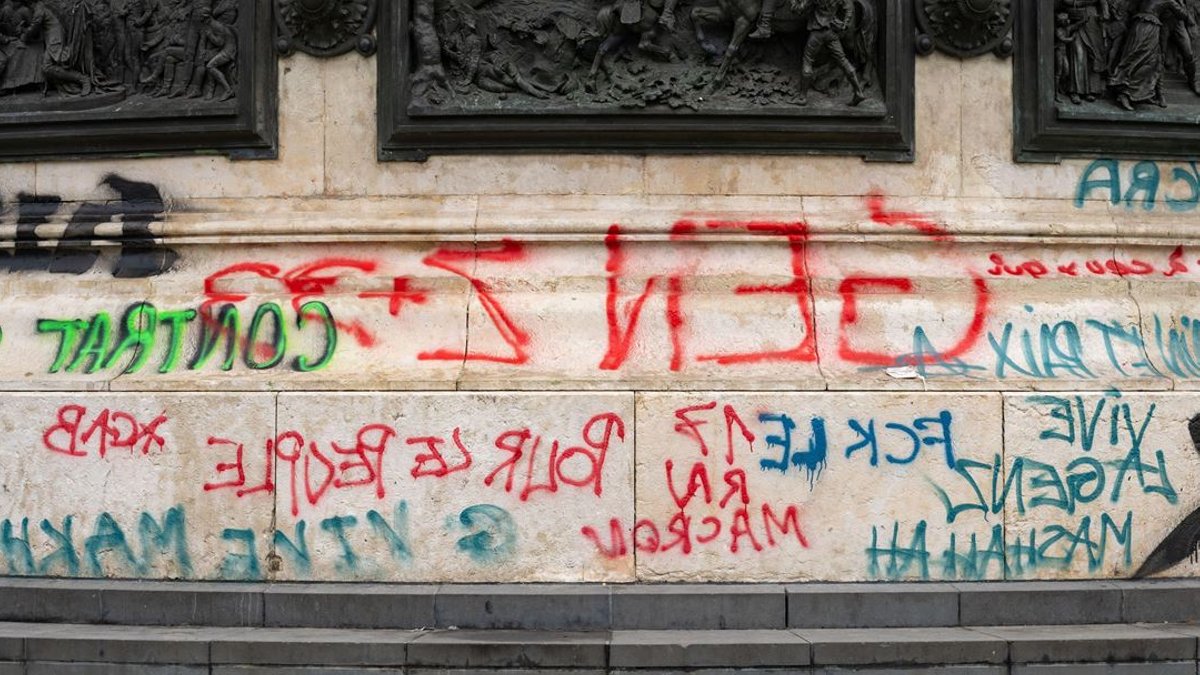
On Place de la République, traces of the protests remained visible. The statue of Marianne, a personification of the French Republic, was coated in fluorescent graffiti. A sign surrounded by flowers read: “To the dead and wounded of the repression.”
Young families played wooden games. Street vendors sold soft drinks. Groups of friends chatted gleefully. The scene was calm, yet the statue drew many people who wanted to take pictures and videos, including international reporters.
The Path Forward
Students and parents question where the money goes. Firdous, a mother of three, cited a lack of teachers in high schools. She said many professors are absent without replacements.


