


Romania struggles as president faces pressure to form government
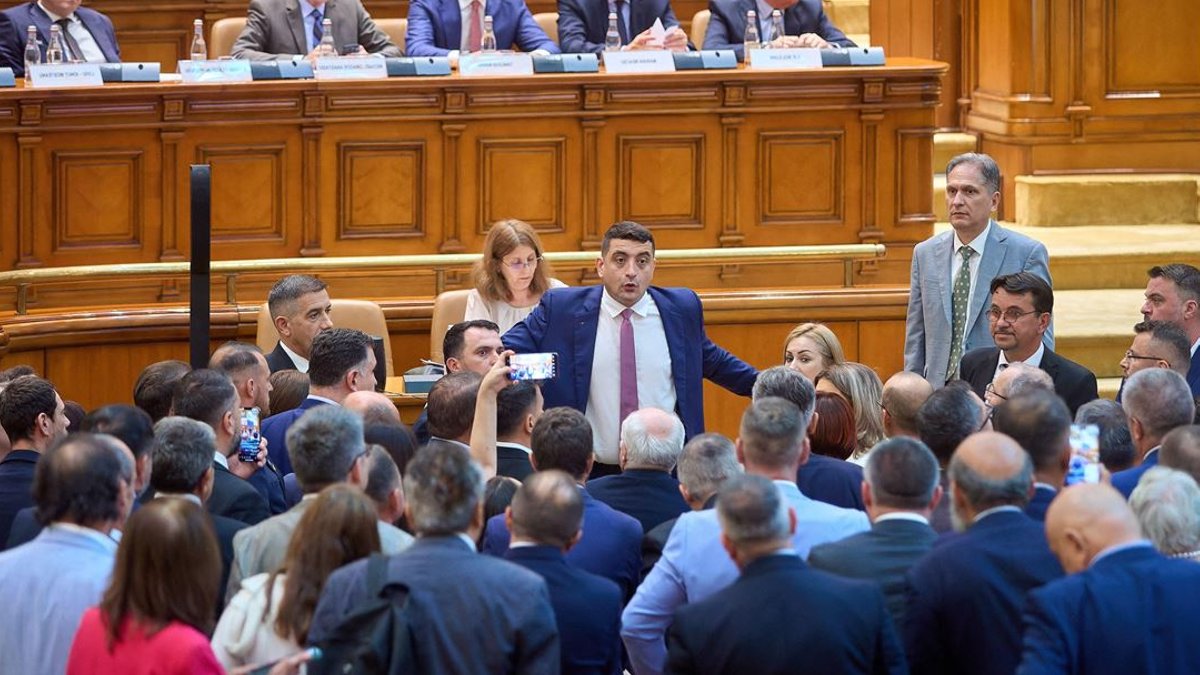
Romania’s political scene has been stagnant for five months, following the collapse of the center-right government in May. The country is grappling with its worst economic crisis in years, coupled with a substantial budget deficit, one of the largest in the EU. President Nicușor Dan is facing mounting pressure to appoint a prime minister who can form a viable government, or consider calling snap elections as a last resort.
Economic challenges and political gridlock
The current political impasse has significant implications for Romania’s economy. The government’s collapse in May was triggered by a vote of no confidence, with the Social Democratic Party and the Alliance for the Union of Romanians (AUR) joining forces to topple Ilie Bolojan’s center-right administration. Since then, three prime ministerial candidates have attempted to form a government, but to no avail. President Dan has now nominated a fourth candidate, Luca Niculescu, a former journalist and ambassador to France, who has a 10-day window to secure the necessary votes to form a government.
The AUR and the Social Democratic Party have consistently rejected the proposed candidates, with Simion stating that there is “no chance” his party would support Dan’s latest nominee if the AUR is not included in the government. Instead, he is advocating for snap elections. Romania’s economic woes have been exacerbated by a series of crises, including a decline in hydropower and nuclear plant production due to low river depths, as well as rising interest rates, which have led to a weakening of the Romanian leu against the euro.
Rating Agency Warns of Junk Status
In 2025, Romania’s budget deficit reached 7.9% of GDP, the highest in the EU, while the country’s growth slowed significantly to less than 1%. The rating agency S&P assigned a BBB- sovereign debt rating to Romania in October, with a negative outlook, warning that a further downgrade could push the country’s debt into junk status, resulting in higher interest rates. President Dan has expressed concerns that holding snap elections or including the AUR in a potential government could spook international creditors, emphasizing the need for a “financially stable trajectory without turbulence.”
Barna Tánczos, deputy prime minister and acting Minister of the Environment, concurs with Dan’s assessment, arguing that new elections would only serve to further destabilize Romania’s economic situation. “Elections are not a solution,” he noted. “As soon as possible, we need a new government and new economic measures to stabilize our finances.” Tánczos warned that if the current budget is not revised and the 2027 budget is not prepared promptly, Romania risks alarming creditors and driving up interest rates.
MEP Siegfried Mureşan, who recently failed to form a government, believes that a coalition is still feasible, provided it includes a clear commitment to further financial reforms. “However, a snap election may eventually become the solution,” he said. “It will always be preferable to a weak government that is unable to take the decisions Romania needs.”
Opposition Capitalizes on Political Instability
Radu Magdin, a former advisor to prime ministers in Romania and Moldova, observes that the country has been heading towards a perfect storm since 2024, when deficits began to rise under the previous government. The opposition right, which has long been excluded from power, senses an opportunity to capitalize on the current political instability. “It’s been annus horribilis for Romania, and when you are in opposition, you capitalize on this,” Magdin said. “You do your manicure while you watch the mainstream political class make a fool of themselves.”
Read Also: Spain set to become net EU budget contributor
Magdin notes that Brussels has often turned a blind eye to Romania’s financial challenges, as it seeks to maintain a pro-EU government in power. However, this has led to festering financial issues. The only party likely to benefit from snap elections is the AUR, which is putting additional pressure on other parties to reach an agreement. Magdin suggests that Luca Niculescu may still be able to form a government with the support of the Social Democratic Party and the National Liberal Party, or potentially with the AUR and the Social Democratic Party.
Simion has expressed sensitivity to the concerns of international creditors, dismissing President Dan’s warnings that the AUR would jeopardize Romania’s financial health. Instead, he proposes to implement a “Milei-model” economic policy, based on radical free market reforms to drastically cut the deficit. “We want more and more foreign investment,” he said. “We want to reduce the bureaucracy that makes it a living hell to bring money to Romania.”
AUR Leader Seeks to Emulate Meloni
As a vice-president of the European Conservatives and Reformists group, Simion has been perceived as skeptical of Brussels. He was supported by Hungary’s former leader and Euroskeptic Viktor Orban during his 2025 presidential campaign and has emphasized the need for a Europe of nations, rather than further integration. Simion’s opponents, including President Dan, argue that an AUR government would threaten Romania’s relationship with the rest of Europe.
Radu Magdin points to countries like Poland and Slovakia, which have had contentious relationships with Brussels. “Romania may have its faults, but Brussels doesn’t consider our faults big faults because we are a constructive country, and they don’t want Romania to transform into a Euroskeptic country,” he said. In an interview with The Parliament, Simion cited Italian Prime Minister Giorgia Meloni as a leader he would like to emulate on the EU level. “I don’t want to be the black sheep who blocks everything,” he said.
Simion expressed opposition to Europe’s green climate legislation, arguing that the bloc should focus more on economic growth. He cited former European leaders like Konrad Adenauer, Charles de Gaulle, and Margaret Thatcher as representing the “original project” of the EU, which should be followed today. The current Romanian government has consistently supported financial aid to Ukraine, including the Ukraine Support Loan, and sanctions on Russia. Simion, who has previously requested compensation for Romania’s assistance to Ukraine, stated that he would support continued EU funding to Ukraine, provided Romania receives a carve-out.
Simion’s Economic Vision and Stance
Simion dismissed Dan’s claims that AUR would hurt Romania’s finances. He promised to institute a “Milei-model” economic policy based on radical free market reforms. The goal is to drastically cut the deficit and attract foreign investment.


